
Data Minimization in Insurance Health Data Governance
How compliance teams limit collected health data without losing underwriting value: data minimization, retention policy, and governance guidance for insurers.
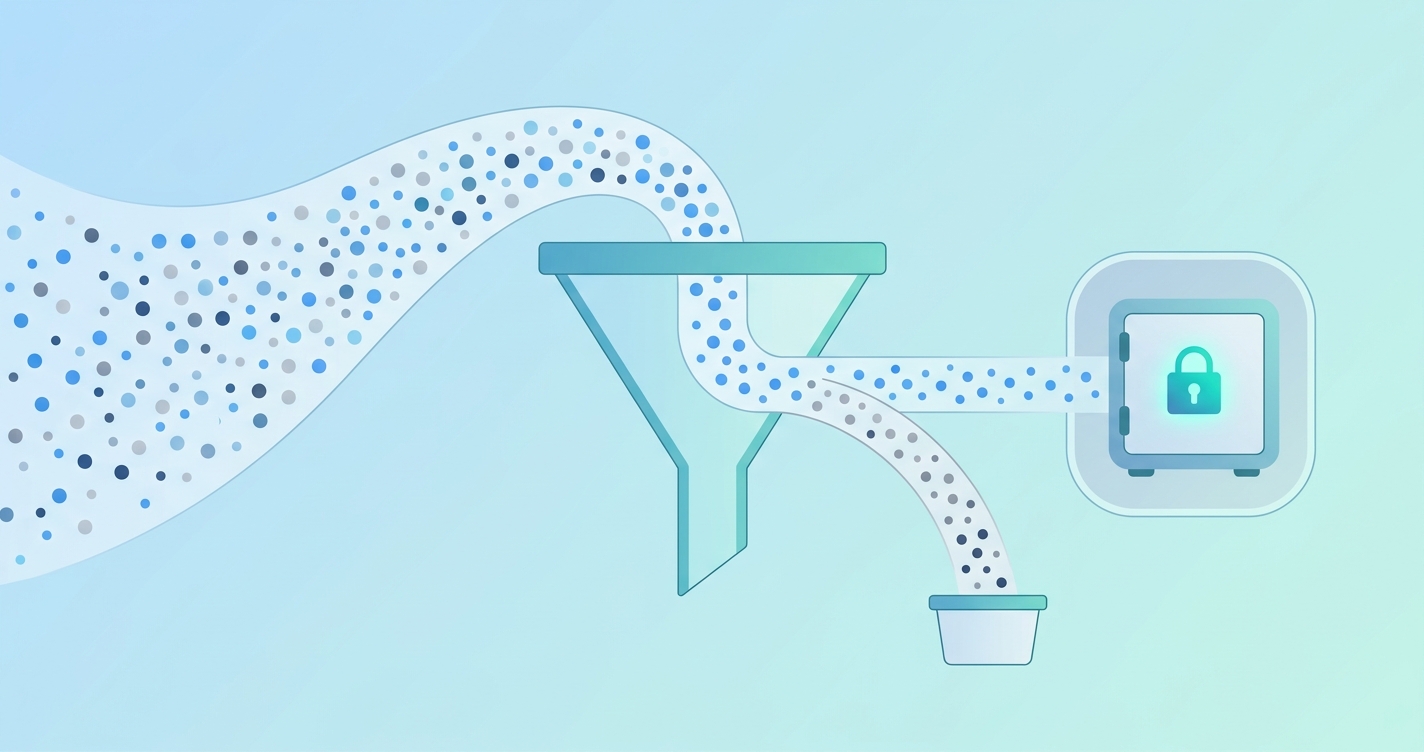
Compliance leaders at life and health carriers are confronting a counterintuitive truth: the volume of health data a program collects has become a liability metric, not an asset metric. As digital underwriting pulls in facial scans, wearable feeds, prescription histories, and clinical records, the question that examiners now ask is no longer whether a carrier can collect a data point but whether it should. Data minimization for insurance health data sits at the center of that shift. Done well, it shrinks breach exposure and regulatory friction while preserving the signals that actually move a risk decision. Done poorly, it either strips out predictive value or leaves carriers holding sensitive records they can no longer justify keeping.
Under GDPR Article 5(1)(c), personal data must be "adequate, relevant and limited to what is necessary in relation to the purposes for which they are processed." A proposed NAIC privacy model circulated in 2024 went further, contemplating deletion of unnecessary personal information within 90 days of the purpose being fulfilled.
What data minimization means for insurance health data
Data minimization is the governance discipline of collecting, processing, and retaining only the health information that a defined underwriting purpose requires, and disposing of it once that purpose ends. The principle predates digital underwriting, but contactless screening has made it operationally urgent. A 30-second video scan can generate raw biometric frames, derived physiological estimates, device metadata, and audit logs. Each layer carries different sensitivity and different retention logic, yet many programs store the entire bundle indefinitely by default.
The UK Information Commissioner's Office frames data minimization as a continuous test against three questions: is the data adequate for the stated purpose, is it relevant to that purpose, and is it limited to what is necessary. The European Health Data Space Regulation, in force since March 2025, sharpened the stakes by prohibiting the use of secondary health data for insurance decisions altogether, signaling that regulators increasingly treat health data as purpose-bound rather than freely reusable.
For US carriers, the National Association of Insurance Commissioners (NAIC) Insurance Data Security Model Law (#668), adopted in 2017, already requires licensees to set a schedule for the retention and secure destruction of nonpublic information. The NAIC Privacy Protections (H) Working Group is drafting amendments to the Privacy of Consumer Financial and Health Information Regulation (#672), with a full draft expected by early 2026, and minimization and retention limits are explicitly on the agenda.
Collected data versus underwriting value
The core tension for compliance and medical leaders is that minimization can look like a threat to predictive accuracy. In practice, most underwriting models rely on a relatively small set of high-signal variables, while the bulk of stored data is either redundant, low-yield, or retained "just in case." The table below maps common health data categories against their underwriting value and their governance burden.
| Data Category | Underwriting Value | Privacy Sensitivity | Suggested Treatment |
|---|---|---|---|
| Derived vitals (estimated blood pressure, heart rate) | High | Moderate | Retain decision-relevant outputs, document derivation |
| Raw biometric capture (video frames, audio) | Low after processing | Very high | Delete after derivation, short fixed window |
| Prescription history | High | High | Collect scoped to product, time-box retention |
| Full clinical records | Variable | Very high | Request only when triggered, segregate access |
| Wearable continuous streams | Moderate | High | Aggregate to features, discard raw stream |
| Device and session metadata | Low | Low | Retain for audit only, minimal fields |
The pattern is consistent: the most sensitive data often carries the least standalone underwriting value once it has been processed into a usable feature. Raw video frames from a scan, for example, become redundant the moment a derived vital is computed and logged. Holding them creates breach exposure with no offsetting decision benefit.
A defensible minimization program typically rests on a few operational commitments:
- Map every data element to a named underwriting purpose before collection begins, not after.
- Separate derived decision features from raw source captures, and apply different retention clocks to each.
- Default to deletion of raw biometric source material once derivation and quality checks are complete.
- Scope third-party data pulls to the specific product and applicant, avoiding bulk acquisition.
- Record the justification for every retained category so an examiner can trace necessity.
Industry Applications
Accelerated and digital underwriting
Programs that compress the application cycle from weeks to minutes generate the largest minimization challenge because they ingest many sources at once. Compliance teams are increasingly inserting a purpose-binding step at intake, where each incoming field is tagged with its underwriting rationale and a retention class. This lets the carrier defend, line by line, why a data point was collected and how long it will live.
Reinsurance and medical director oversight
Reinsurance medical directors reviewing ceded blocks need enough clinical signal to validate risk selection, but they rarely need raw source data. A minimization-aware architecture exposes derived features and decision rationale to reviewers while keeping raw captures segregated under tighter access controls. This satisfies oversight without widening the population of people who can see sensitive material.
Privacy compliance in underwriting operations
Minimization is also a practical answer to consumer access and deletion requests. When a carrier can show that raw biometric material is purged on a short fixed schedule and only derived, decision-relevant fields persist, it can respond to data subject requests faster and with less manual reconciliation. The same discipline supports privacy compliance underwriting reviews during market conduct examinations.
Current research and evidence
The regulatory record now points clearly toward minimization as an enforceable expectation rather than a best practice. The NAIC Insurance Data Security Model Law (#668), adopted in 2017 and enacted in a growing number of states, requires a documented retention and destruction schedule for nonpublic information, with HIPAA's six-year standard taking precedence where health records are involved. The proposed NAIC privacy model floated in 2024, which contemplated deletion of unnecessary personal information within 90 days of purpose completion, drew industry resistance precisely because it would force carriers to operationalize minimization at speed.
In Europe, GDPR Article 9 classifies health data as special category data requiring an explicit legal basis and heightened safeguards, and Article 5(1)(c) makes minimization a binding principle subject to enforcement. The Digital Operational Resilience Act, applicable from January 2025, raised ICT and data risk management to a board-level responsibility for insurers, while the European Health Data Space Regulation, in force March 2025, barred the reuse of secondary health data for insurance decisions outright. Taken together, these instruments reframe stored health data as a standing obligation that must be continuously justified.
Guidance from accounting and advisory firms such as Baker Tilly has reinforced that practical data governance in insurance depends on clear ownership, classification, and retention rules rather than on accumulating data for hypothetical future use. The consistent finding across regulators and advisors is that necessity, not availability, should govern collection.
The future of data minimization in insurance
Three trajectories are emerging. First, privacy-enhancing computation, including on-device derivation and feature extraction that discards raw inputs before they ever reach carrier systems, will let programs capture signal without capturing source material. Second, retention automation will move from policy documents to enforced controls, with time-boxed deletion wired directly into data pipelines so that minimization is provable rather than asserted. Third, examiners will increasingly treat the data map itself as a primary artifact, expecting carriers to demonstrate purpose binding and disposal on demand.
The carriers best positioned for the 2026 NAIC model revisions are those treating minimization as an architectural choice made early, not a remediation project bolted on after collection. The cheapest sensitive record to govern is the one a program never stored in the first place.
Frequently asked questions
Does data minimization reduce underwriting accuracy?
Not when it is applied to redundant or post-processing data. Most predictive lift comes from a small set of derived features. Raw source captures and bulk records typically add governance burden without proportional decision value, so removing them after derivation rarely changes outcomes.
What retention period applies to insurance health data?
There is no single universal period. The NAIC Data Security Model Law requires a documented schedule, HIPAA generally imposes a six-year standard for covered health records, and many state insurance record laws specify around five years. Raw biometric captures can often be deleted far sooner once derivation is complete.
How does minimization interact with consumer deletion requests?
Minimization makes deletion requests easier to honor. When raw source material is purged on a fixed schedule and only scoped, decision-relevant fields persist, the carrier has fewer records to locate, reconcile, and remove when an applicant exercises a privacy right.
Is data minimization a US or EU requirement?
Both. GDPR Article 5(1)(c) makes it a binding principle in Europe, and US regulators are codifying equivalent expectations through the NAIC Data Security Model Law and the in-progress Privacy of Consumer Financial and Health Information Regulation amendments.
Circadify is building underwriting compliance tooling that treats data minimization as default architecture, mapping each health data element to a named purpose and a defensible retention class. Compliance officers evaluating their current exposure can start with a structured data governance assessment and review related regulatory insights at circadify.com/industries/payers-insurance.